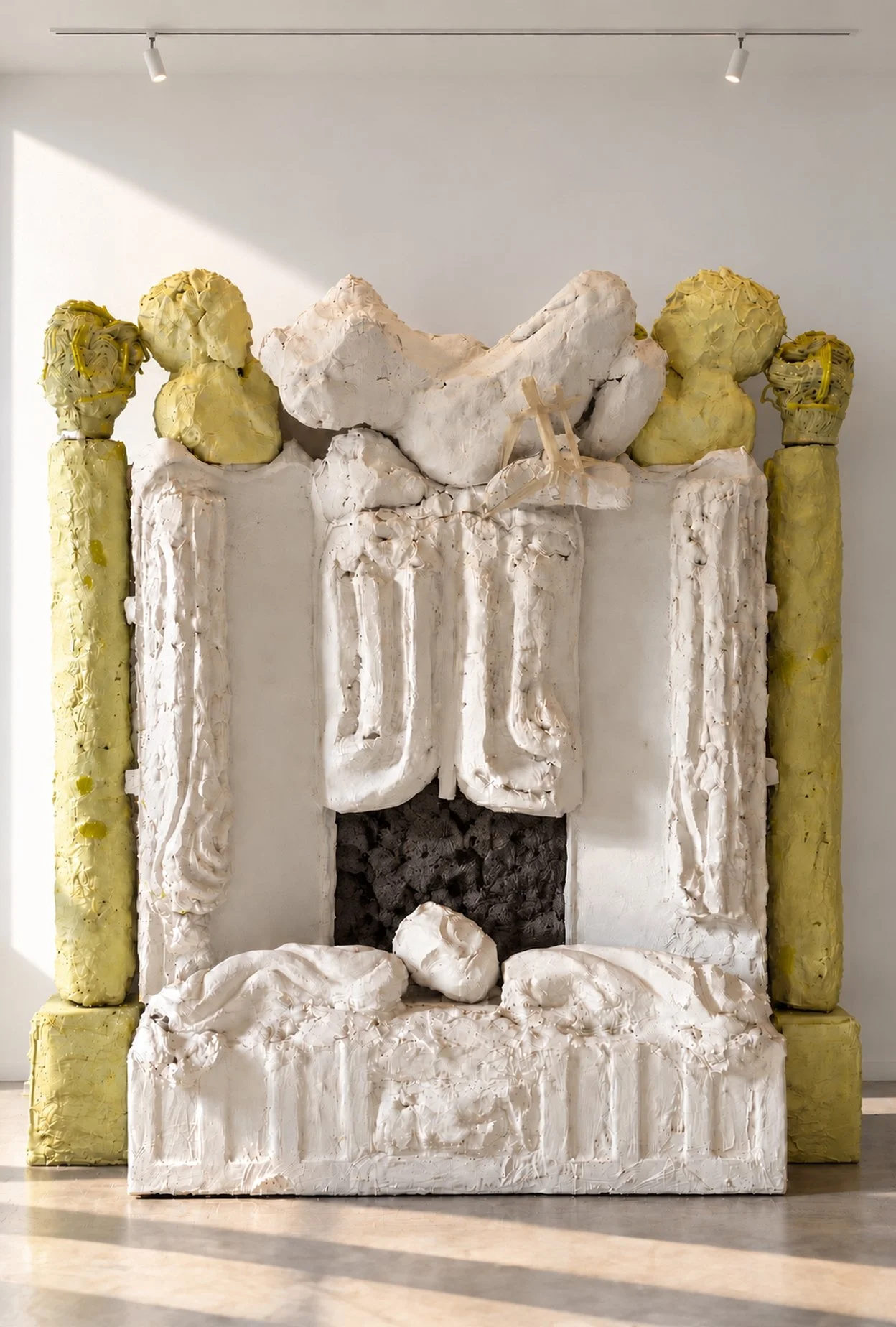
How Long It Takes To Fall
2026
Plaster, foam, resin, sugar, rope, cardboard, lacquer, dowels.
How Long It Takes to Fall moves between artifact and invention, asking how history is preserved, reconstructed, and claimed. Having grown up in a place where land, history, and cultural inheritance are continually negotiated, Zilberman approaches antiquity as something unstable—remembered, interpreted, displaced, and possessed.
Zilberman sculpts these figures from memory rather than historical or anatomical accuracy. They move freely across time, collapsing ancient forms and contemporary visual culture into an imagined archaeology. She is interested in the romance we project onto antiquities—the desire to preserve them, possess them, and imagine the lives contained within them. She returns to the image of putting lipstick on a rock: something intimate and cosmetic applied to something seemingly permanent, as though the object could be brought back into the present or made alive again.
Embedded within the sculpture are remnants of Zilberman’s earlier sugar works, preserved inside these new forms like relics. The sculpture becomes both monument and sarcophagus, holding the remains of objects that were always intended to disappear. Ultimately, the representational subject is less important to Zilberman than how the object came into being, what it contains, and what will happen to it over time. How Long It Takes to Fall exists somewhere within that duration—the distance between making something, loving it, preserving it, and watching it become a ruin.